
From Assembly Question to Pink Bus: New Route Opens a Safer, Affordable Road to Education for Jehanabad’s Women and Girls
Pink Bus: For women and girl students in rural Jehanabad, travelling to yhe capital patna...
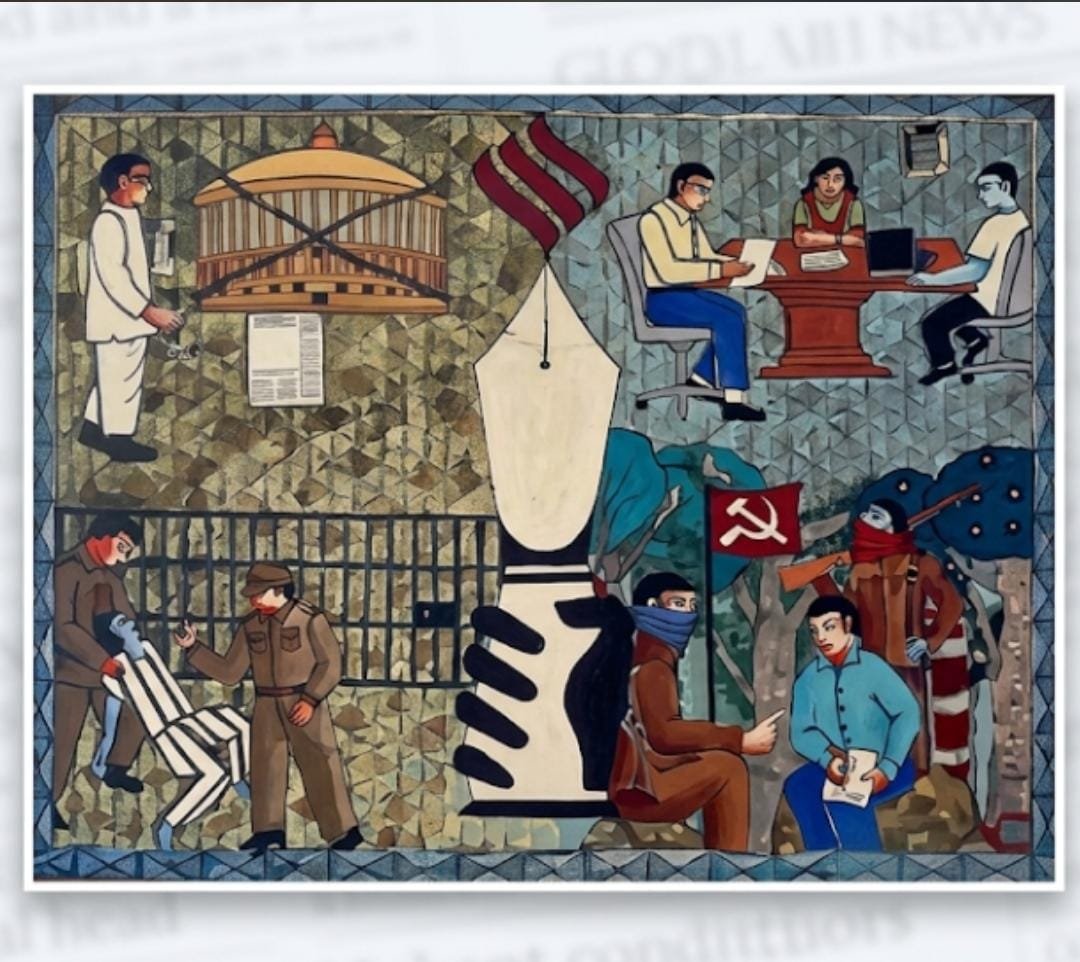
PATNA: Sometimes, a painting does more than occupy a wall. It preserves an era.
For Madhubani artist Chitra Singh, one such painting has been hanging quietly in her living room for years. A smaller print of a much larger work that once travelled from Patna to Delhi, the painting was born out of an unusual request from The Indian Express nearly a decade ago: to interpret, through art, the newspaper’s enduring theme—“Journalism of Courage.”
She chose not to illustrate the phrase literally. Instead, she went looking for moments when journalism had been tested by power, danger and uncertainty.
She selected four episodes from the history of The Indian Express: the Emergency, the investigation into Bihar’s infamous “ankhphodwa” or blinding case, the international investigation represented by the Panama Papers, and the life of a reporter working in the Naxal-affected countryside.
The choice was entirely hers.
She brought these disparate episodes together in a large Madhubani-inspired composition, transforming a newspaper’s institutional motto into a visual narrative about journalism—its risks, responsibilities and moral memory.
The painting was taken to Delhi and presented to the newspaper’s editors. It found a place on the wall of the Indian Express editorial office.
And She kept a smaller print for herself.
Years later, the painting acquired another meaning.
The reporter whose world had found a place inside that artwork met Chitra Singh for the first time.
What followed was more than a meeting between an artist and the subject of her work. It was an encounter between memory and journalism, art and lived experience.
For the journalist, seeing the painting again meant confronting a chapter of a profession that once demanded something far more visceral than deadlines and digital dashboards.
There was a time when reporting meant entering places where the distance between a story and danger could be frighteningly small. In the Naxal belt, particularly, journalism was not merely about reaching a location and filing a report. It could mean negotiating uncertainty, travelling through difficult terrain, listening to people who lived outside the gaze of the state, and returning with a story that carried the weight of lives lived on the margins.
That world of journalism survives in Singh’s painting.
So does another history—the history of journalism confronting authority.
The Emergency represents one of the most consequential moments in India’s press history, when censorship and restrictions on the media placed journalism under extraordinary pressure. The Bihar blinding cases, meanwhile, became a defining example of investigative reporting exposing allegations of custodial brutality and abuse of power.
Then came journalism on a global scale: the Panama Papers, an enormous international investigation into offshore financial structures that demonstrated how journalists across countries could collaborate to investigate information that crossed borders.
And finally, there is the reporter in the Naxal landscape—the individual journalist standing closest to the ground, often farthest from institutional protection.
Four moments. Four different forms of risk.
Her decision to place them in one frame gave the phrase “Journalism of Courage” a human dimension.
A Painter’s Reading of Journalism
What makes the story particularly compelling is that Singh was not herself a newsroom insider. She approached journalism from the perspective of an artist.
That distance may have been precisely what allowed her to see something journalists themselves often fail to notice: that journalism is also a form of witnessing.
A reporter observes. An artist interprets.
A reporter records what happened. An artist preserves what the moment felt like.
The resulting painting therefore became more than a tribute to a newspaper. It became a conversation between two traditions of storytelling—the written word and the painted image.
A very insightful post about this remarkable story was recently shared on Facebook by veteran journalist and author Ashutosh Bhardwaj.
Chitra Singh is the wife of veteran Bihar journalist Santosh Singh, a journalist known for his sharp news instincts and his long engagement with the political and social life of Bihar. He has also authored books including The Jannayak and Ruled and Misruled: The Story and Destiny of Bihar, reflecting his sustained engagement with the state’s political history and its complicated relationship with power.
For a journalist like Santosh Singh, Bihar is not merely a beat. It is a landscape of political upheavals, caste and social transformations, crime, development, conflict and competing narratives about the state’s destiny.
Perhaps that is why the painting feels particularly at home there.
When the Subject Meets the Artist
There is something almost cinematic about the moment: a journalist encountering, years later, an artist who had once tried to capture the very world in which he had worked.
The painting becomes a kind of time machine.
It takes the reporter back to an era when journalism could be physically dangerous, when stories were pursued beyond the comfort of the newsroom, and when the line between professional duty and personal risk could become remarkably thin.
As the journalist looked at the work, memories of that older profession returned—the romance of reporting before journalism became overwhelmingly digital, before every breaking story was measured in clicks, impressions and engagement.
It was a time when life sometimes moved on the edge of a knife, and nights seemed to dance to the fragrance of mahua.
The phrase may sound poetic, but it captures something essential about reporting from Bihar’s difficult landscapes: the intimacy between journalist and terrain, danger and discovery, fear and fascination.
The painting had preserved that memory without ever knowing precisely whose memory it would eventually awaken.
Art as Journalism’s Second Archive
Newspapers preserve history in columns and archives. Artists preserve it differently.
Singh’s painting is, in that sense, an alternative archive of journalism.
It does not tell the reader what happened in the manner of a newspaper report. It asks the viewer to remember why those moments mattered.
That distinction is important.
News moves quickly. Art moves slowly.
A newspaper is read and replaced.
A painting remains.
And sometimes, years after a headline has disappeared from the front page, a painting can bring the emotional truth of that moment back into the room.
That is what happened in Patna.
An artist, a painting and a journalist came together—and with them came an entire chapter of India’s journalistic memory.
The artist had painted journalism’s courage. Years later, the subject returned to stand before the painting.
0 Comments
No comments yet. Be the first to comment!